
Bachelor of Music (B.M.) in Music Therapy
Music Therapy Program
The Music Therapy program at the University of Tennessee at Chattanooga prepares students to become board-certified music therapists through a combination of academic study and clinical training.
Music therapy is an evidence-based clinical practice that uses structured music experiences to support non-musical goals. These may include cognitive, emotional, social, communication, motor, and wellness outcomes.
Students learn how to design and implement therapeutic interventions such as:
- Music listening
- Singing
- Instrumental performance
- Songwriting
- Improvisation
What Music Therapists Do
Music therapists work with individuals across the lifespan in a variety of settings. They use music to support:
- Cognitive development
- Communication skills
- Motor coordination
- Social interaction
- Emotional expression and well-being
The field of music therapy is supported by decades of research, with ongoing studies continuing to expand its clinical impact.

Learning Experience at UTC
UTC music therapy students engage in both classroom instruction and hands-on learning experiences.
Through this approach, students develop:
- Critical thinking skills
- Communication skills
- Problem-solving abilities
These skills directly support success in clinical practice.
Clinical Training and Fieldwork
Students gain experience working with diverse clinical populations through supervised field placements. These experiences help students:
- Apply classroom knowledge in real-world settings
- Build professional skills
- Develop a foundation for lifelong learning and reflection
Students also collaborate on community-based music programs, using music to support growth and positive change.
Curriculum and Faculty Support
UTC faculty and staff provide structured academic and clinical instruction across:
- Music foundation courses
- Clinical foundation courses
- Music therapy courses
The program emphasizes:
- Competency-based skill development
- Professional identity formation
- Ethical and reflective practice
Students are supported in developing a strong sense of self as future music therapy professionals.
The Accreditation and Professional Standards
The UTC Music Therapy program follows the standards and guidelines of the American Music Therapy Association, including:
- Code of Ethics
- Professional Competencies
- Standards for Education and Clinical Training
The program is fully approved by:
- American Music Therapy Association
- Tennessee Higher Education Commission
The University of Tennessee at Chattanooga is also an accredited member of the National Association of Schools of Music.
Ready to Become a Music Therapy Major?
- Course Overview

Bachelor of Music (B.M.) in Music Therapy
Total Credit Hours: 124
General Education (34 hours)
(see Certified General Education Courses for the list of approved courses)
Rhetoric and Communication: (6 hours)
- Complete two approved courses in rhetoric and communication
Humanities and Fine Arts (12 hours)
- Complete four approved courses from at least two prefixes (i.e., ART, ENGL, HIST, MUS)
- MUS 1110 - Introduction to Music
- MUS 3110 - Musics of the World
- One approved Humanities and Fine Arts course outside of MUS prefix
- One approved Humanities and Fine Arts course outside of MUS prefix
Natural Sciences: (4 hours)
- Complete one approved natural science course, including a laboratory component
Behavioral and Social Sciences: (6 hours)
- PSY 1010 - Introduction to Psychology
- One approved behavioral or social science course other than Psychology
Quantitative and Reasoning: (3 hours)
- One approved quantitative and reasoning course
Individual and Global Citizenship: (3 hours)
- Complete one approved individual and global citizenship course
Music Therapy Curriculum
Music Foundations (44 hours)
- MUS 1710 - Musicianship I
- MUS 1720 - Musicianship II
- MUS 1730 – Aural Skills I
- MUS 1740 – Aural Skills II
- MUS 1750 - Musicianship Lab I
- MUS 1760 – Musicianship Lab II
- MUS 2050r – Fundamentals of Music Composition
- MUS 2710 – Musicianship III
- MUS 2720 – Musicianship IV
- MUS 2730 – Aural Skills III
- MUS 2740 – Aural Skills IV
- MUS 2750 – Musicianship Lab III
- MUS 2760 – Musicianship Lab IV
- MUS 3030 – Basic Conducting
- MUS 3110 – Musics of the World#
- MUS 3150 – History of Music I
- MUS 3160 – History of Music II
- Ensemble participation (7 hours/semester).
- 4 semesters (4 hours) of 2000-level primary applied study.
Clinical Foundations (17 hours)
- PSY 1010 – Introduction to Psychology
- PSY 2210 – The Psychology of Child Development
- PSY 2220 – The Psychology of Adolescence and Adulthood
- MUS 1820 - Beginning Dance for the Music Therapist (3)
- MUS 3800 - Anatomy & Physiology for the Music Therapist (3)
- EDUC 2200 – Survey of Exceptional Learners (3)
- HHP 0021 – Concepts of Wellness (1)
Music Therapy Concentration (26-28 hours)
- MUS 1360R - Guitar Class for Music Therapists (2 semesters)
- MUS 1810 - Introduction to Music Therapy (3)
- MUS 2810 - Music Therapy Clinical Skills (2)
- MUS 3810 - Music Therapy Principles and Foundations (3)
- MUS 3820 - Music Therapy Applications (3)
- MUS 3830r - Music Therapy Practicum (1 hour/4 semesters)
- MUS 4210 - Psychology of Music (3)
- MUS 4820 - Music Therapy Measurement and Research (3)
- MUS 4830 - Music Therapy Internship (6)
Electives (3 hours)
Additional Requirements for all Music Therapy Majors:
- All coursework must be completed prior to enrolling in MUS 4830 - Music Therapy Internship.
- Successful completion of Continuation Standards is a prerequisite to enrollment in upper-division music courses and Music Therapy concentration courses.
- A seminar is required each semester of residence. A minimum of 8 semesters with a grade of SATISFACTORY is required.
- For graduation: 2.0 GPA in all required major and related courses (including specified General Education courses).
- 2.75 average cumulative, including 2.75 average at UTC and 2.75 average in content area coursework with no grade lower than C.
- Minimum of 39 hours of 3000 and 4000 level courses
- See Degree and Graduation Requirements for additional requirements.
#Also satisfies General Education requirement.
Clear Path for Advising
Students should familiarize themselves with their Clear Path before seeking advisement.
Please see the Course Catalogue for more information.
- Audition Requirements
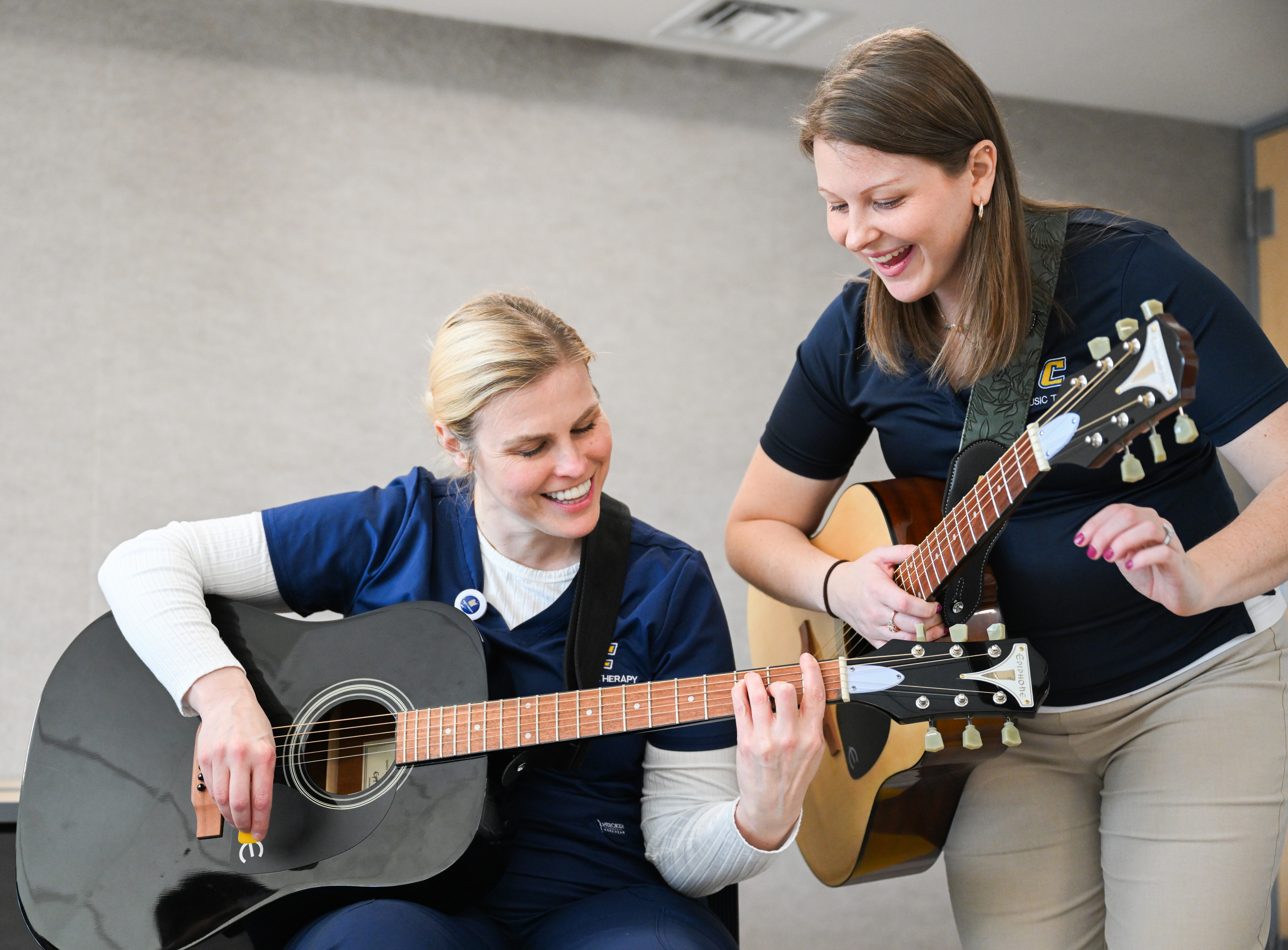
All music therapy majors are expected to perform appropriate undergraduate repertoire; demonstrate musicianship, technical proficiency, and interpretive understanding on a principal instrument/voice.
Also, majors should be able to perform in small and large ensembles. Each music therapy major is required to complete a total of four semesters of applied study on their principal instrument/voice at the 2000-level. Placement into the applied level of study is determined by audition. Please see the audition requirements for your principal instrument here.
Music therapy majors who have studied guitar as a secondary instrument and proficiently demonstrate the foundational skills listed below, are eligible to be exempt from the first-semester guitar requirement. Please contact Professor Katherine Goforth Elverd directly to schedule your audition for guitar.
- Lead and accompany proficiently on guitar.
- Play basic chord progressions in several major keys with varied accompaniment patterns.
- D Major (I, IV, V)
- G Major (I, IV, V)
- A Major (I, IV, V)
- E Major (I, IV, V7)
- C Major (I, IV, V)
- Play basic minor chords - E minor, A minor, and D minor.
- Play and sing basic repertoire on guitar (traditional, folk, and/or popular songs) with lead sheets.
- Sing in tune with a pleasing quality and adequate volume with guitar accompaniment.
- Tune guitar using standard tuning.
- Care for and maintain the guitar.
- Music Therapy Equivalency Program
UTC offers a music therapy equivalency program for post-baccalaureate students seeking board certification in music therapy. This track allows a student who holds a degree in a complementary field to earn an equivalent to a bachelor’s degree in music therapy, in preparation for the board certification exam. Therefore, students are taking courses in music foundations, clinical foundations, and music therapy foundations. Students eligible to complete the music therapy equivalency program who hold a minimum of a bachelor’s degree in a complementary field from an accredited institution with a degree in the area of:
- Music
- Psychology
- Education
- Nursing
- Social Work
- Physical Therapy
- Occupational Therapy
- Communication Science and Disorders
- Mental Health Counseling
Please note that students who hold a bachelor’s degree outside the listed complementary fields must complete the Bachelor of Music, Concentration in Music Therapy track.
Music therapy equivalency students are required to complete the following outlined music therapy equivalency coursework. UTC will honor previously completed coursework that meets the program requirements and is documented on an official transcript.
Music Foundations
- MUS 1110 – Introduction to Music
- MUS 1710 – Musicianship I
- MUS 1720 – Musicianship II
- MUS 1750 – Musicianship Lab I
- MUS 1760 – Musicianship Lab II
- MUS 2050r – Fundamentals of Music Composition
- MUS 3030 – Basic Conducting
- MUS 3160 – Music History II
- 4 semesters (3 hours) of 2000-level primary applied study
- 1 semester (1 hour) of ensemble
Clinical Foundations
- PSY 1010 – Introduction to Psychology
- PSY 2210 – The Psychology of Child Development
- PSY 2220 – The Psychology of Adolescence and Adulthood
- PSY 3080 – Principles of Abnormal Psychology
- BIOL 2060 – Functional Human Anatomy
- EDUC 2200 – Survey of Exceptional Learners
- HHP 0021 – Concepts of Wellness
- HHP 0052 – Beginning Modern Dance
Music Therapy Concentration
- 2 semesters (2 hours) Guitar Class or Guitar Instruction
- MUS 1810 – Introduction to Music Therapy
- MUS 2810 – Music Therapy Clinical Skills
- MUS 3810 – Music Therapy Principles and Foundations
- MUS 3820 – Music Therapy Applications
- MUS 3830R – Music Therapy Practicum (4 hours/semester)
- MUS 4210 – Psychology of Music
- MUS 4820 – Music Therapy Measurement and Research
- MUS 4830 – Music Therapy Internship
Additional Requirements for all music therapy equivalency students:
Students are required to complete a formal audition on their primary instrument for acceptance into the music division.
All coursework must be completed with appropriate grade requirements before enrolling in MUS 4830 Music Therapy Internship.
2.75 average cumulative, including 2.75 average at UTC and 2.75 average in content area coursework with no grade lower than C.
Clear Path for AdvisingPlease see the Courses' section of this catalog for complete course descriptions.
If you are interested in learning more about the music therapy equivalency program,
Please contact Professor Katherine Goforth Elverd directly.


Jordan Hicks
First Year Coordinator
State Office Building 101 and Fine Arts Center 328B