Representations of the ‘Other’: Jews in Medieval Christendom

NEH Summer Institute
  11 July-15 August, 2006
Oxford, England


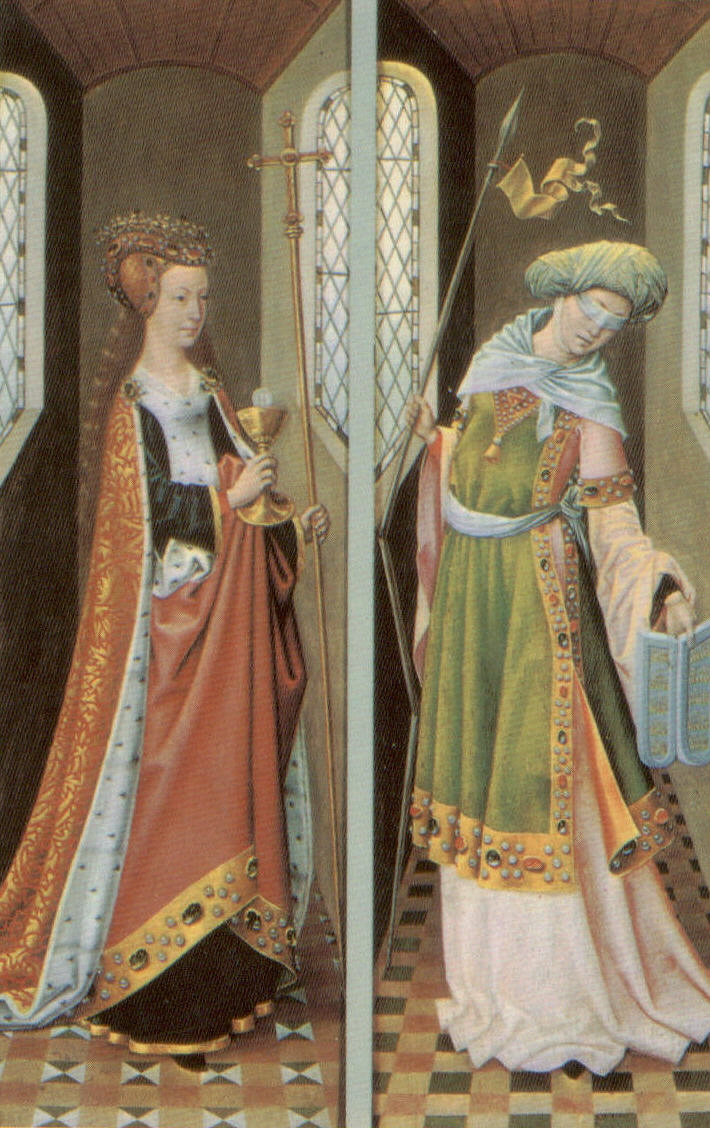
Cover photo from Heinz Schreckenberg, The Jews in Christian Art (originally published as Die Juden in der Kunst Europas. Ein Bildatlas
Göttingen: Vandenhoeck & Ruprecht, 1996; reproduced by permission). A painting  by the "Master of the Ursula Legend" (late 15th Century), depicting synagoga, with eyes covered, in an oriental turban.
Director: Irven M. Resnick (University of Tennessee at Chattanooga)
e-mail: Irven-Resnick@UTC.EDU

Visiting Faculty:

Description
Venue
Libraries
Schedule
Housing
Computer Facilities
Travel
Car Rental and Rail Passes
Banking
Cultural Events
Welcome Gathering
Useful Telephone Numbers
Climate
Medical Insurance
Additional Information
Curriculum and Calendar
Applications
Application Cover Sheet
2006 Participants

Archives of 2003 Program
Profiles and Contact Information for 2003 Faculty and Participants
2003 Curriculum and Calendar

Description:
    Although in the early Middle Ages ‘otherness’ had largely been defined in terms of  language, custom, law, or religion, by the fourteenth century other features  emerge as the basis of group identity, creating a seemingly insurmountable obstacles to assimilation and acculturation. These new constructions of ‘otherness’ may help explain the deteriorating status of Jewish (and Muslim) communities in Europe, which led to the eventual expulsion from most lands in Christendom of those who refused baptism. Even baptism, however, could not wash away this newly established sense of difference: in Spain after 1492 Moriscos and Conversos  (i.e. recent Muslim and Jewish converts to Christianity) remained under suspicion and were subject to discrimination under a series of statutes relating to purity of blood, perhaps anticipating modern racial conceptions.
    This evolution of medieval European conceptions of ‘otherness’ and the various efforts of contemporary scholars to explain it will constitute the field of study for this institute. Treating the experience of Jews as paradigmatic, ‘otherness’ will be examined across a number of disciplines: history, philosophy, theology, canon law, literature, and art history.

Program Venue and Size: Yarnton Manor, OCHJS Administrative Offices
     Twenty-five college and university faculty members will be selected to participate in the program. Each participant will receive a $3600 stipend to help defray expenses. The program will be conducted at the Oxford Centre for Hebrew and Jewish Studies (OCHJS). Located on its own campus in Yarnton, four miles from the center of Oxford, OCHJS is an independent academic post-graduate institution associated with the University of Oxford. (For OCHJS web site, see http://associnst.ox.ac.uk/ochjs.) Its campus offers a modern library with more than 40,000 volumes, common rooms, and housing. Since the academic year at OCHJS will already have ended, institute participants will share the OCHJS campus only with its permanent and visiting fellows.

Libraries:
    Institute participants will have the status of visiting faculty members, enabling them to obtain privileges at Oxford's Bodleian library and related university libraries. Library hours during the summer months, when the university is not in session, are generally shortened. The Leopold Muller Memorial Library  at OCHJS is open Monday-Friday from 10:00 A.M. until 5:00 P.M., although institute participants should be able to check out books to their rooms to assist their research. The university Bodleian library is open Monday-Friday from 9:00 A.M. until 7:00 P.M., and from 9:00 A.M. until 1:00 P.M. on Saturdays, with the exception of the August Bank Holiday Weekend. Individual college libraries are closed or maintain irregular hours outside the academic term. Participants who wish to examine materials in college libraries are advised to make an appointment with the college librarian. Successful candidates who wish access to Oxford University libraries should notify the program director by 1 June, and should bring several passport photos with them to Oxford. As a group, we'll visit Bodleian offices to obtain readers' cards. 

Back to Top of Page

Schedule:
     Lecture-discussions and seminars will meet Monday, Tuesday, Thursday, and Friday. Wednesdays are reserved for optional meetings, trips, and group discussion with visiting faculty, or may be designated for private research and reading in the University libraries. On typical Monday and Friday mornings, presentations will be scheduled from 9:30-10:15, followed by a short break, with discussion continuing from 10:30 to noon. Tuesday and Thursday meetings will be held from 9:30-11:30 and 1:00-3:00.

  Please note that our program calendar overlaps with some sessions scheduled at the International Medieval Congress in Leeds, which meets from 10-13 July 2006 (see http://www.leeds.ac.uk/ims/imc/imc2006.html). If you plan to attend the Congress, or to deliver a paper, please be sure to arrange your schedule so that you will be available for our formal meetings beginning on the morning of 12 July.
 

Housing:
    All of Ricardo House, the graduate student residence at OCHJS, has been reserved for participants. It contains sixteen private rooms arranged in four suites. Each suite consists of four comfortable private bedrooms around a shared kitchen and bath. These rooms are fairly large (about 15’X20’), fully furnished with bed, wardrobe, chest of drawers, desk and desk chair, an easy chair, and bathroom sink. For photos of Ricardo House rooms, click here. The rooms also have a telephone. Internal calls are free; local calls outside OCHJS cost 6 pence/minute (this is standard; even private homes pay a per minute telephone charge).
    Each cluster of 4 bedrooms shares a kitchen equipped with a microwave, full-sized electric range with oven, and a refrigerator with freezer. They also share a bath, equipped with toilet, tub and hand-held shower. 2003 participants in the senior common room On each floor there is a large common room with a dining table and chairs, easy chairs, and a television (although cable TV is not available in Yarnton). Sheets and towels will be exchanged weekly, and maid service will be provided twice each week All pots, pans, utensils, plates, etc. are provided for cooking. Rooms will be made available to participants at a reduced rate of £1000 (approximately $1765; exchange rates will fluctuate) for the entire five-week period. Laundry facilities are available on site.
    We have made arrangements to pay for housing at OCHJS simply by deducting the cost from your stipend. This will save individual participants both the bother and the considerable expense of purchasing a money order in pounds (£).
    If you would like to reside at OCHJS (which I strongly recommend), I will need to know no later than 1 May, 2006. This gives you approximately one month to explore other options, should you choose to do so.

    Check-in will be on 11 July between 9:00 A.M and 12:30 P.M. and 2:00 and 4:30 P.M. at the OCHJS reception office in the manor house. If you would like to arrive in Oxford or Yarnton before 11 July, please contact the institute director. If you would like to spend a night (or more) in London before or after our program, you should inquire about housing for academics at Goodenough Club (at the London Goodenough Trust). Consult the trust’s web site at http://www.lgt.org.uk, or write the club directly at club@goodenough.ac.uk.
    Participants, whenever possible, are strongly encouraged to remain on the OCHJS campus. Most of our housing at OCHJS, however, is intended for singles. Although the program director can offer some assistance in locating off-campus housing, participants who plan to bring family members should attempt to make their own arrangements. Please consult the classified ads in the university’s Oxford Gazette at http://www.ox.ac.uk/gazette (Click on “Weekly Issues,” select a week, and then click on “Advertisements: Houses—or flats—to Let”). You’ll also find some links for short term rentals at http://www.oxfordcity.co.uk/accom/property.html. Please be advised, however, that summer rentals in Oxford can be expensive. If you require family housing, or would prefer to live away from the OCHJS campus, you may also wish to consult one of the many rental agents in the Oxford area. For a list with web site addresses, click here. You may also want to check classified ads in Oxford newspapers; you can access property listings and obtain other information by exploring http://www.thisisoxfordshire.co.uk. Finally, you'll  find a number of listings of flats or houses to rent at http://www.dailyinfo.co.uk.
    Just as housing in Oxford can be very expensive, so too restaurants and groceries will be more expensive than what one encounters in most cities in the U.S. As a rule of thumb, you may expect that most grocery items and restaurants will cost 25%-50% more than you might expect to pay at home.

Back to Top of Page

Computer Facilities:
    It is recommended that institute participants bring laptop computers. OCHJS is working to become a completely wireless campus. Participants will be able to access the internet or web-based e-mail from anywhere on campus. Participants without a laptop will have access to computers in the library at OCHJS.  However, participants should understand that computer facilities on-site likely do not equal those at their home institutions.

Travel:
    Successful applicants must have a passport, valid for at least six months beyond the end date of our program. Each participant will arrange travel to England independently. The nearest airports are London’s Heathrow and Gatwick. Alternatively, it is possible to fly to Manchester, although the ground travel time will be somewhat longer than from London. I would recommend that you consider flights to Manchester only if you find that fares are less expensive than those to London. For directions to Yarnton from London airports, click here for directions from  Heathrow;  click here for directions from Gatwick North or here for Gatwick South. Oxford Bus Company express buses leave every 20 minutes from Heathrow Airport, 24 hours each day, and every hour from Gatwick Airport. For airport bus information for Oxford or from central London, see the Oxford Bus Company. For bus service between Oxford and central London, see the Oxford Tube for times and fares. The trip requires about 1 hour and 45 minutes each way, depending on traffic. It is also possible to rent a car at the airport or to travel from London to Oxford by train, although trains depart less frequently.
    Upon first arrival at Oxford’s Gloucester Green bus terminal, we recommend that participants take a taxi to OCHJS in Yarnton. Tell the taxi driver to drop you at Yarnton Manor, on Church Lane in Yarnton (a distance of 5-6 miles). The fare will be around £12. City buses also travel from Oxford to Yarnton, although the nearest stop is perhaps ¼ mile away from OCHJS accommodations. For bus and rail travel timetables, fares, and routes in and to Oxford, click here.
OCHJS also runs a shuttle bus service from its campus to stops in Oxford; participants will be provided with an unlimited ride pass. For the summer shuttle timetable, click here. Even with bus and shuttle service, however, participants should be prepared regularly to walk distances of ¼ mile or more.

Car Rental and Rail Passes
    If you plan to rent a car in England, let me advise you to make arrangements before you leave the States—you’ll usually find a better rate. You might check http://www.europcar.com for competitive rates. If you are planning weekend touring during your stay in England, you can find information about rail passes and other travel information at http://www.raileurope.com/us/index.htm.

Banking
    For a short stay, it does not make sense to open a local bank account (the process can take weeks!). Instead, I would recommend using a debit card to obtain cash from an ATM machine. These machines are ubiquitous. In England, banks cannot charge a fee when you use a debit card from another bank; your home banking institution may do so, however. You should check with your bank to determine the amount of the fee, and your daily withdrawal limit. Also, make certain that your card can be used at overseas locations. Typically, exchange rates when using an ATM card are quite favorable.
    Another option is to purchase Travellers Checks in £. A bank will cash them, as will currency exchange windows. Some retail outlets will not accept them, however, making them less useful than the debit card. Even those outlets that do accept travellers checks will require proof(s) of identification.
 

Cultural Events
 Although OCHJS is located outside the city of Oxford, a fifteen minute bus ride delivers the visitor to the city's center. Even during summer break, Oxford is a busy, vibrant city with many entertainment opportunities. For a quick look at Oxford's offerings, see the Oxford Visitor's Guide at http://www.oxfordcity.co.uk. In addition, we plan various gatherings and social events for institute participants on the OCHJS campus. Although there are no athletic facilities on the campus, there are extensive gardens, as well as paths for walking and biking.

Welcome Gathering:
    I have planned a welcome gathering for all participants on 11 July at 6:00 PM at the Manor House in Yarnton. There, you’ll meet Peter Oppenheimer, President of the Centre, as well as the other participants. You’ll also learn more about our schedule and program at that time. Other social events are also being considered—e.g. a bus tour of Oxford, wine and cheese evenings, picnics, pub tours, etc. We plan to offer a guided tour of one of Oxford's oldest colleges, Christ Church. Also we plan to have a walking tour of medieval Jewish Oxford. If you have any particular requests or suggestions for such events, please let me know.

Useful Telephone Numbers
    The telephone number for the administrative offices at OCHJS is (01865) 377946. Note that when calling from the U.S., you must first dial the international code (011), then the country code, (44), then the city code (01865), followed by the local number 377946. When calling from the U.S., omit the “0” in the city code (01865). The FAX number at OCHJS is (01865) 375079.

Climate
    The average Oxford temperature during July and August is 16° Celsius, or about 66° F. This is an average of daytime and overnight temperatures. Most days will be between 65° F-75° F; most nights temperatures will fall to 55° F-60° F. But be advised that England does occasionally suffer a heat wave (temperatures in the 80s or even 90s), and most buildings are not air conditioned, including those at OCHJS. Be certain to bring a light jacket, an umbrella, and comfortable walking shoes. Also, although you should dress for comfort, note too that at the university libraries you will likely receive looks of disapproval if you wear a tank top, shorts, and sneakers.

Medical Insurance
    Participants should make certain that they have adequate medical insurance coverage for travel to England. Many HMO plans provide coverage only for emergency room treatment. However, several insurers provide special riders or medical plans for travelers. For an example of such a plan, see STA Travel

Additional Information
    Additional travel instructions, as well as specific  information on the program syllabus, will be provided on this site in the next few months. In the interim, please direct questions to Professor Irven M. Resnick via e-mail (Irven-Resnick@UTC.EDU) or phone (423) 425-4446; FAX (423) 425-4153.

Curriculum and Calendar

Faculty:
Professor Jeremy Cohen (Tel Aviv University)
Professor Daniel J. Lasker, Norbert Blechner Professor of Jewish Values (Ben-Gurion University of the Negev)
Associate Professor Sara Lipton (SUNY-Stony Brook)
Professor Robert Stacey (University of Washington)
Professor Miri Rubin (Queen Mary, University of  London)
Professor Irven Resnick (University of  Tennessee, Chattanooga)

Texts recommended for review before the beginning of the institute
  1. Abulafia, Anna Sapir. Christians and Jews in the Twelfth Century Renaissance. London; New York: Routledge, 1995. ISBN: 0415000122.
  2. Chazan, Robert. Daggers of Faith: Thirteenth-Century Christian Missionizing and the Jewish Response. Berkeley: University of California Press, 1989.
  3. Cohen, Jeremy. Living Letters of the Law: Ideas of the Jew in Medieval Christianity. Berkeley: University of California Press, 1999. ISBN: 0520216806
  4. Cohen, Jeremy, ed.  From Witness to Witchcraft: Jews and Judaism in Medieval Christian Thought. Wolfenbutteler Mittelalter-Studien, Bd. 11. Wiesbaden: Harrassowitz, 1996. (essays from parts 1 and 4)
  5. Moore, R.I. The Formations of a Persecuting Society: Power and Deviance in Western Europe, 950-1250. Oxford, New York: B. Blackwell, 1987. ISBN: 0631171452.
  6. Lasker, Daniel J.  Jewish Philosophical Polemics Against Christianity. New York: KTAV, 1977. ISBN: 0870684981.
  7. Berger, David. The Jewish-Christian Debate in the High Middle Ages. Philadelphia: Jewish Publication Society of America, 1979. Introduction. ISBN: 0827601042.
  8. Hood, John Y. B. Aquinas and the Jews. Philadelphia: University of Pennsylvania Press, 1995. ISBN 0812215230.

Week I. July 11-18 Asserting Oneself through Negating the Other

Tuesday, 11 July: Evening Gathering

Wednesday, 12 July: Morning session and Orientation (Irven M. Resnick)

Thursday, 13 July (Jeremy Cohen):

Morning session: Contours of the Jewish Experience in Medieval Christendom

       Read:

    Afternoon session: St. Augustine and the Jew

      Read:

Friday, 14 July:  Jews as 'Other' in Early Medieval Europe (Jeremy Cohen)

      Read:

Monday, 17 July: Monasticism and Spirituality in the Twelfth Century (Jeremy Cohen)

           Read:

Tuesday, 18 July (Jeremy Cohen):
Morning session: The High Medieval Papacy

      Read:

Afternoon session: Missionaries, Theologians, and their Legacy

Read:

Wednesday, 19 July: Informal Meetings
Week II. July 20-26

Thursday, 20 July: Rationalism and Theology from Anselm to Abelard (Irven Resnick)

       Read:

Friday, 21 July: Signs of Otherness in Medieval Art and Literature (Sara Lipton)

Jews in Gothic Art: Topics to be covered include typological iconography, identifying signs, Synagoga personified, host desecration imagery, Passion iconography.

        Read:

Monday, 24 July: Signs of Otherness. (Sara Lipton).
Jews in Gothic Art. (Continued)
          
Tuesday, 25 July:
(Sara Lipton)

Morning session: Representations of Heresy and Witchcraft. Topics include the visual conflation of Jews and heretics, heresy as diseaser, accusations of animal worship, sexual and gendered polemics, images of the devil.

        Read:

    Afternoon session: The Non-European Other. An examination of depictions of Muslims and Africans.

       Read:

Wednesday, 26 July: Informal Meetings

Week III. July 27-August 2

Thursday, 27 July: Animosity toward Jews and Popular Culture (Miri Rubin)
       Morning Session: Jews at the Heart of a Christian Worldview, 1100-1250
            Read:

       Afternoon session: Narrative Assaults: Murders and Desecrations 1250-1350

       Read:

Friday, 28 July: Animosity toward Jews and Popular Culture (Miri Rubin)

       Read:


Monday, 31 July: Jewish-Christian Literary Polemics and Public Disputations. The Beginnings of the Jewish      Daniel Lasker
    Critique of Christianity (Daniel Lasker)   

Read:

Tuesday, 1 August: The Transition of the Jewish critique of Christianity to Christendom. (Daniel Lasker)

        Read:

Wednesday, 2 August: Public Disputations  (Daniel Lasker)

       Read:

Week IV. August 3-9

Thursday, August 3: Informal Meetings

Friday, 4 August:  Philosophical Polemics (Daniel Lasker)

       Read:


Monday, 7 August: The First Century of English Jewish History, 1066-1154 (Robert Stacey)

       Read:

Tuesday, 8 August:  The Angevin Era Begins, 1154-1236 (Robert Stacey)
    Morning Session:

       Read:

    Afternoon Session: The Thirteenth Century Crisis

       Read:

Wednesday, 9 August:  A Walking Tour of Jewish Oxford (Optional)

Week V. August 10-15

Thursday, 10 August:  The Re-emergence of Ritual Crucifixion Tales (Robert Stacey)

    Morning Session:

       Read:

    Afternoon Session: The Edwardian Experiment?

       Read:

Friday, 11 August: Antisemitism and Expulsion

       Read:

Monday, 14 August: Depictions of Jews in Scientific and Medical Literature (Irven M. Resnick)

       Read:

Tuesday, 15 August: Concluding session.

Back to Top of Page


Applications:

    Summer Institutes for College and University Teachers are offered by the National Endowment for the Humanities to provide college and university faculty members and independent scholars with an opportunity to enrich their understanding of significant ideas, texts, and topics in the humanities. Institutes focus on an intensive study of texts, topics, and ideas central to undergraduate teaching in the humanities under the guidance of faculties distinguished in their fields of scholarship. They aim to prepare participants to return to their classrooms with a deeper knowledge of current scholarship in key fields of the humanities.

Eligibility:
    These projects are designed primarily for teachers of American undergraduate students. Qualified independent scholars and those employed by museums, libraries, historical societies, and other organizations may be eligible to compete provided they can effectively advance the teaching and research goals of the institute. Applicants must be United States citizens, residents of U.S. jurisdictions, or foreign nationals who have been residing in the United States or its territories for at least the three years immediately preceding the application deadline.
    Applicants must complete the NEH application cover sheet and provide all the information requested below to be considered eligible. Applicants must have completed professional training by the application deadline. An applicant need not have an advanced degree in order to qualify. Candidates for degrees are generally not eligible. Adjunct and part-time lecturers are eligible to apply.  Individuals must not apply to seminars directed by scholars with whom they have previously studied, nor may one apply to study with a director of a seminar or institute who is a current colleague or a family member. Individuals must not apply to seminars directed by scholars with whom they have previously studied. An individual may apply to no more than two NEH seminars or institutes in any one year.

Selection Criteria:
    A selection committee will evaluate all complete applications in order to select the most promising applicants and to identify a small number of alternates. The Institute selection committee consists of the project director and two colleagues. Selection committees are charged to give first consideration to applicants who have not participated in an NEH-supported seminar or institute in the last three years.
    The most important consideration in the selection of participants is the likelihood that an applicant will benefit professionally. This is determined by committee members from the conjunction of several factors, each of which should be addressed in an application essay of no more than 3-4 pages. These factors include:
1. quality and commitment as a teacher, scholar, and interpreter of the humanities;
2. intellectual interests, both generally and as they relate to the work of the institute;
3. special perspectives, skills, or experiences that would contribute to the institute;
4. commitment to participate fully in the formal and informal collegial life of the institute;
5. and the likelihood that the experience will enhance the applicant's teaching and scholarship

    When choices must be made among equally qualified candidates, several additional factors are considered: preference is given to applicants who have not previously participated in an NEH seminar or institute, or who would significantly contribute to the diversity of the seminar or institute. Institute selection committees are advised that only under the most compelling and exceptional circumstances may an individual participate in an institute with a director or a lead faculty member who has previously guided that individual's research or in whose previous institute or seminar he or she has participated.

Stipend, Tenure, and Conditions of Award:
    Individuals selected to participate in  five-week projects will receive $3,600. Stipends are intended to help defray travel expenses to and from the project location, books and other research expenses, and living expenses for the duration of the period spent in residence. Adjustments in cases where the stipend is insufficient to cover all expenses are not possible. Institute participants may wish to apply  their home institutions for additional travel funds, to help with the expense of travel to England.
    Institute participants are required to attend all meetings and to engage fully in the work of the project. During the project's tenure, they may not undertake teaching assignments or any other professional activities unrelated to their participation in the project. Participants who, for any reason, do not complete the full tenure of the project must refund a pro-rata portion of the stipend.
    At the end of the project's residential period, participants will be asked to submit evaluations in which they review their work during the summer and assess its value to their personal and professional development. Special forms for this report will be distributed by each project director. Completed forms should be returned directly to the Endowment. They will become part of the project's grant file and may become part of an application to repeat the institute.

Application Instructions:
    Before completing an application, please read the letter from the project director that contains information about the topic under study, and project requirements and expectations of the participants. Information pertaining to the the academic and institutional setting,  specific provisions for lodging, subsistence, and extracurricular activities, will be found there and above on this web site. If you cannot open this letter, please request a copy from the director before you attempt to compete and submit an application. All application materials should be sent to the project director. Sending application materials and reference letters to the Endowment will result in delay. The project director's address is:

Professor Irven M. Resnick
Department of Philosophy and Religion (Dept. #2753)
University of Tennessee at Chattanooga
615 McCallie Ave.
Chattanooga, TN 37403-2598
(423) 425-4446 (voice); (423) 425-4153 (FAX)

Checklist of Application Materials:
The following items constitute a completed application to the summer  institute:
- three copies of the completed application cover sheet,
- three copies of a detailed résumé (not to exceed 5 pages),
- three copies of an application essay as outlined below, and
- two letters of recommendation (sent separately).

The Application Essay:
    The application essay should be no more than four double-spaced pages. This essay should include any relevant personal and academic information. It should address reasons for applying; the applicant's interest, both academic and personal, in the subject to be studied; qualifications and experiences that equip the applicant to do the work of the seminar or institute and to make a contribution to a learning community; a statement of what the applicant wants to accomplish by participating; and the relation of the project to the applicant's professional responsibilities. Applicants to institutes may need to elaborate on the relationship between institute activities and their responsibilities for teaching and curricular development.

Reference Letters:
    Two referees should be chosen carefully. They should be familiar with the applicant's professional accomplishments or promise, interests, and ability to contribute to and benefit from participation in the institute. They should specifically address these issues in their recommendations. Letters from colleagues who know the applicant's teaching and from those outside the applicant's institution who know his or her scholarship are often more useful than letters from college or university administrators. Referees should be provided with copies of the director's description of the seminar or institute and the applicant's essay. If an applicant has previously participated in an NEH summer seminar or institute, a recommendation from the director or lead scholar of that program would be useful. It is the applicant's responsibility to ask the referees to send their letters directly to the project director and to make certain that their letters are mailed to arrive not more than one week after the March 1 deadline.

Submission of Applications and Notification of Award:
    Completed applications should be submitted to the project director and should be postmarked no later than March 1, 2006. The application deadline has been extended to March 15, 2006 only for individuals in areas affected by Hurricane Katrina. For more information, click here. Successful applicants will be notified of their selection by April 1, 2006, and they will have until April 15 to accept or decline the offer. Applicants who will not be home during the notification period are advised to provide an address and phone number where they can be reached. No information on the status of applications will be available prior to the official notification period.

Equal Opportunity Statement:
Endowment programs do not discriminate on the basis of race, color, national origin, sex, disability, or age.  For further information, write to the Equal Opportunity Officer, National Endowment for the Humanities, 1100 Pennsylvania Avenue, N.W., Washington, D.C. 20506.  TDD:  202/606‑8282 (this is a special telephone device for the Deaf).


Application Cover Sheet

The application cover sheet must be filled out on line at this address:  http://www.neh.gov/online/education/participants. Please fill it out on line as directed by the prompts. When you are finished, be sure to click on the “submit” button.  Print out the cover sheet and add it to your application package.  At this point you will be asked if you want to apply to another project.  If you do, follow the prompts and select another project and then print out the cover sheet for that project.  Note that filling out a cover sheet is not the same as applying, so there is no penalty for changing your mind and filling out cover sheets for several projects.  A full application consists of the items listed above, as sent to a project director.      

Back to Top of Page

NEH Logo

2006 Participants

Mark A. Amos (Department of English, Southern Illinois University, Carbondale)
Irma Ned Bailey (Department of English, San Antonio College)
Elizabeth Berlings (Department of English and Speech, St. John’s University)
Nancy Bishop (Art Department, Arkansas Tech University)
Carlee A. Bradbury (School of Art and Design, Southern Illinois University, Carbondale)
Joseph Byrne (Honors Program, Belmont University)
Adriano R. Duque (Romance Languages, Kenyon College)
Mark E. Gammon (Department of Religion and Philosophy, Simpson College)
Jonathan E. Glixon (School of Music, University of Kentucky)
Jacqueline A. Gutwirth (Department of History, Bronx Community College)
Laura H. Hollengreen (School of Architecture, University of Arizona)
Karen M. Kletter (Department of History, Methodist College)
Ernesto Lombeida (Department of Foreign Languages, Arkansas State University)
Esther M. Martinez (Department of Languages and Cultures,William Paterson University)
Karen S. Nicholas (Department of History, Oswego State University)
Frances C. Novack (Department of Modern Languages, Ursinus College)
Merrall L. Price (Department of English, Oklahoma State University)
Kevin Reilly (Humanities and Social Science, Raritan Valley Community College)
Paul R. Rovang (English and Theatre Arts, Edinboro University of Pennsylvania)
Thomas Saylor (Department of History, Concordia University, St. Paul)
Judy Schaaf (Department of English, University of Massachusetts, Dartmouth)
Jane B. Schlubach (Humanities and Philosophy, University of Central Oklahoma)
Kristine T. Utterback (Department of History, University of Wyoming)
Toni Wein (Department of English, California State University, Fresno)
Nancy J. Weston (Art Department, St. Cloud State University)